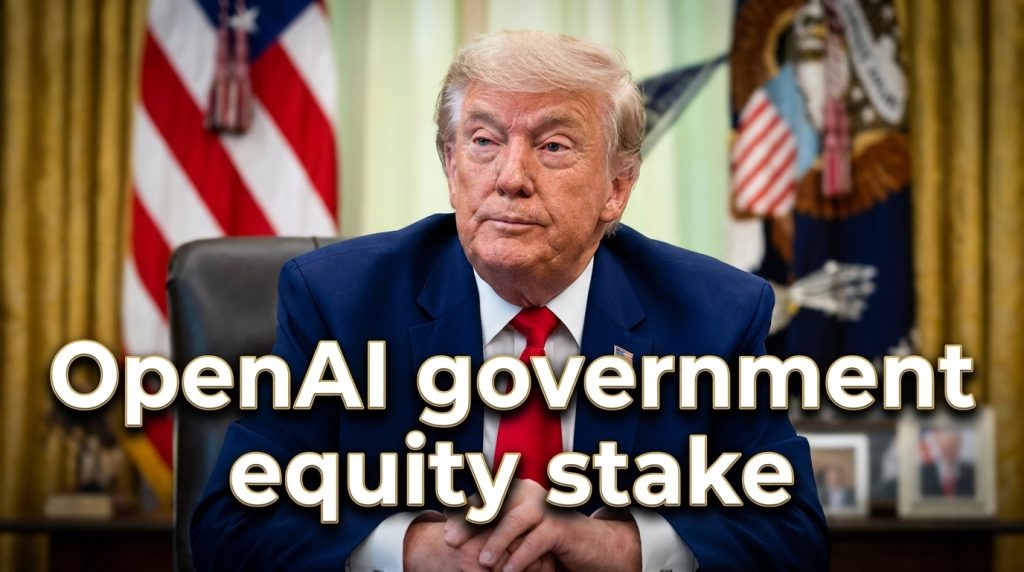
In a move without real precedent in Silicon Valley, OpenAI has proposed handing over a piece of itself to the very government that regulates it. The OpenAI government equity stake proposal, first reported by the Financial Times, would give Washington a 5 percent ownership position in the company, valued at roughly $42.6 billion based on OpenAI’s most recent $852 billion valuation.
Rather than resisting regulatory pressure, OpenAI appears to be leaning directly into it, and the OpenAI government equity stake offer is being widely read as an attempt to reset a relationship that had grown increasingly tense in recent months.
Why OpenAI made this offer now
The timing behind the OpenAI government equity stake proposal is difficult to separate from recent friction between the company and federal officials. OpenAI had already delayed the release of its GPT-5.6 model at the administration’s request, while fellow AI developer Anthropic was separately ordered to restrict access to certain of its own models over national security concerns. Against that backdrop, offering equity appears to be a calculated move by CEO Sam Altman to regain operating flexibility rather than continuing to absorb regulatory friction indefinitely.
Altman has reportedly discussed the OpenAI government equity stake concept directly with President Trump, Commerce Secretary Howard Lutnick, and Treasury Secretary Scott Bessent, indicating this isn’t a passing suggestion but a proposal being actively pursued at the highest levels of both the company and the administration.
How this fits into a broader pattern
The OpenAI government equity stake idea doesn’t exist in isolation. The Trump administration has already taken ownership positions in roughly twenty private companies through equity, warrants, and so-called golden shares spanning sectors from minerals to semiconductors to quantum computing. Perhaps most notably, the government’s roughly 10 percent stake in Intel, originally taken after officials had called for the company’s CEO to resign, has since grown to a position worth more than $60 billion.
Viewed against this backdrop, the OpenAI government equity stake offer looks less like an isolated negotiating tactic and more like OpenAI positioning itself within an emerging pattern of how the administration prefers to engage with strategically important technology companies.
The vision behind a broader AI wealth fund
Altman’s proposal extends well beyond OpenAI alone. Under the framework being discussed, the OpenAI government equity stake would be just one piece of a larger arrangement in which other leading AI developers, including Google, Meta, and Anthropic, would contribute similar equity slices into a shared government investment vehicle. The model being referenced is the Alaska Permanent Fund, the state-owned corporation that invests Alaska’s oil revenue and distributes annual dividends directly to residents.
Whether other major AI companies would actually agree to a similar arrangement remains unclear, and the OpenAI government equity stake proposal is just one input into a much larger and more contentious debate in Washington over how the public should benefit financially from the AI boom.
Why critics are raising conflict of interest concerns
Not everyone views the OpenAI government equity stake favorably. Watchdog groups have raised pointed concerns about the structural conflict created when the same government body acts as both regulator and financial stakeholder in the companies it oversees. Public Knowledge, a Washington-based nonprofit focused on technology policy, has been particularly direct about this tension, arguing that a government with a financial stake in OpenAI’s success has a built-in incentive to go easier on safety oversight than it otherwise might.
This criticism cuts to the heart of why the OpenAI government equity stake proposal has generated so much debate, since it forces a genuinely difficult question about whether a government can simultaneously act as an impartial regulator and a profit-motivated shareholder in the same company.
How this compares to more aggressive alternatives
The OpenAI government equity stake proposal represents a relatively moderate position compared to some alternatives being floated in Congress. Senator Bernie Sanders has proposed a far more aggressive American AI Sovereign Wealth Fund Act, which would impose a one-time 50 percent tax on AI company stock, funneling the proceeds into a public wealth fund rather than relying on companies to voluntarily offer equity stakes as OpenAI has done.
This contrast highlights just how wide the range of proposed approaches to AI industry taxation and public benefit-sharing has become, with the OpenAI government equity stake sitting somewhere in the middle between unrestricted private ownership and Sanders’s considerably more aggressive nationalization-adjacent approach.
What happens next with the IPO timeline
Complicating the picture further, OpenAI has confidentially filed paperwork for a potential U.S. initial public offering, with Altman reportedly insisting on a valuation floor that some company advisers have described internally as difficult to achieve given current market conditions. A finalized OpenAI government equity stake arrangement would add real complexity to this already unprecedented offering, since investors evaluating the IPO would need to account for the government’s ownership position and its potential influence over the company going forward.
Any formal arrangement is also likely to require congressional approval, meaning the OpenAI government equity stake, even if both sides ultimately agree to terms, faces a genuinely uncertain legislative path before it could be finalized.
What this could mean going forward
If the OpenAI government equity stake arrangement moves forward, and if other major AI companies follow with similar contributions, it would mark a genuinely new chapter in how the American government interacts with its most strategically significant technology companies. Whether this becomes a template other nations attempt to replicate with their own domestic AI companies remains an open question, one that industry analysts are already beginning to debate as this story continues developing.
For now, discussions around the OpenAI government equity stake remain in an early, conceptual stage, according to reporting, but the fact that the conversation is happening at all signals just how significantly the relationship between government and the AI industry has shifted in recent months.